
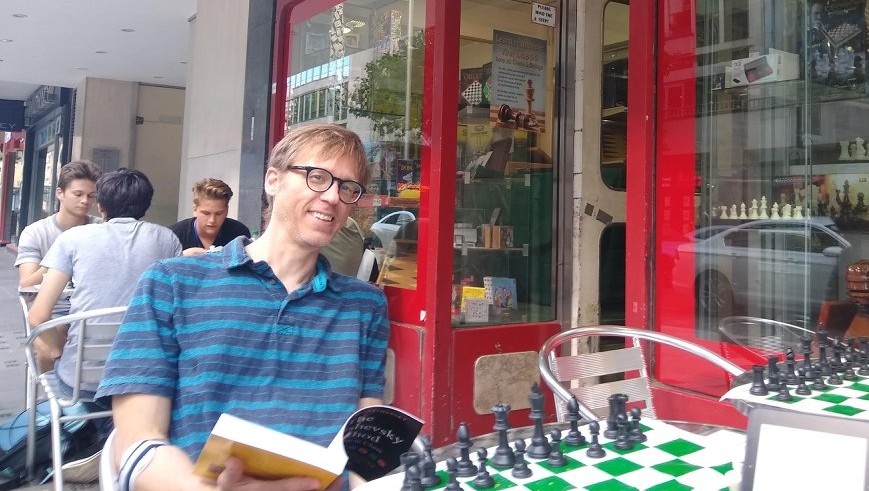
Conversations in the Club is our ongoing series introducing the people who make Edinburgh Chess Club the special place that it is. Each post offers a glimpse into the personalities, stories, and passions behind our community. Today we sit down for a coffee and a chat with…
What is your name and playing strength?
Michael Ridge, FIDE 1893, Chess Scotland 1914 [live], ECF 2014
What is your relationship to Edinburgh Chess Club?
I’ve been a member since I moved here in 2001. Alongside my pal Chris Sykes I coached the Tiger Cubs for 6 years when my son, Benjamin Ridge played for them, and I’ll always cherish those years and the friendships I made coaching so many talented young juniors. I’m currently joint Vice-President of the Club (alongside Keith Aitchison) and I play for Edinburgh 2 in the League and have for literally decades now!
What do you love most about chess?
This is a hard one! The rich history of the game, the beauty of a fantastic combination or idea, the friendships it has provided all come to mind. Perhaps the thing I most value about the game itself is the way in which it forges virtues – the ability to be self-critical, to take losses in your stride, to be patient, to concentrate, to think logically, and so on. I also like what you might call the “message” or ideology of chess – the idea that “good moves win.” The world would be a better place if this were more universally true, but in politics and other contexts, sadly, bad moves (e.g. bad arguments or ideas) all too often prevail. In this sense, chess provides a sort of ideal for human existence. The fact that hard work tends to pay off and that you are insulated from bad luck also appeals.
Related: I am also a professional philosopher, and I teach a class on the philosophy of play and games, and I also publish in this area, fairly extensively. Here is a video inspired by one of my papers on play, games, and Stoicism, for example: https://www.youtube.com/watch?v=e50yA4mXaT8&t=145s
Although I often use chess as a leading example in my published works, this is the only paper I have specifically on chess, but it is, unfortunately, somewhat densely argued and draws somewhat on background familiarity with the philosophy of games: https://journals.uio.no/JPG/article/view/10845
Who is your favourite player/streamer?
My favourite player would be a toss up between Capablanca, Bobby Fischer and Mikhail Tal, but if I had to choose right now it would be Capablanca as his ability to make it all look so damn simple [it isn’t!] is incredible. My favourite streamer is probably the tragically recently deceased Naroditsky, whose course on endgames was incredible and whose general style of streaming really appealed to me, but honourable mentions to Jesse Kraai and Ben Finegold.
What is your favourite book/online course/learning resource?
Favourite chess book – Seven Deadly Sins, Jonathan Rowson. I’ve gotten a lot out of the site chesslecture.com over the years, so perhaps I’ll mention that though of course Chessable also is great and I enjoy the perpetual chess podcast.
What advice would you give to fellow chess players?
Consider taking up meditation! I could give a lot of other advice, but this is the least likely to overlap with anyone else’s from our club. My coach strongly recommended it and I’ve found it surprisingly effective at helping me concentrate at the board, even doing only 10 minutes a day regularly. Obviously, there is no substitute for hard work, doing puzzles, studying endgames and openings, analysing your own games and those of the great masters, but I would guess meditation is the most bang for the buck that I would bet my colleagues at the club won’t be mentioning.
Thanks Mike!
[The solution to our puzzle last time is Bc6!! – this way, White defends the g2 square from behind – an x-ray defence through the black queen! Then, after …Qxc6 White follows up with Rxb8+ Kh7; Qa8! repeating the same trick…amazing stuff.]